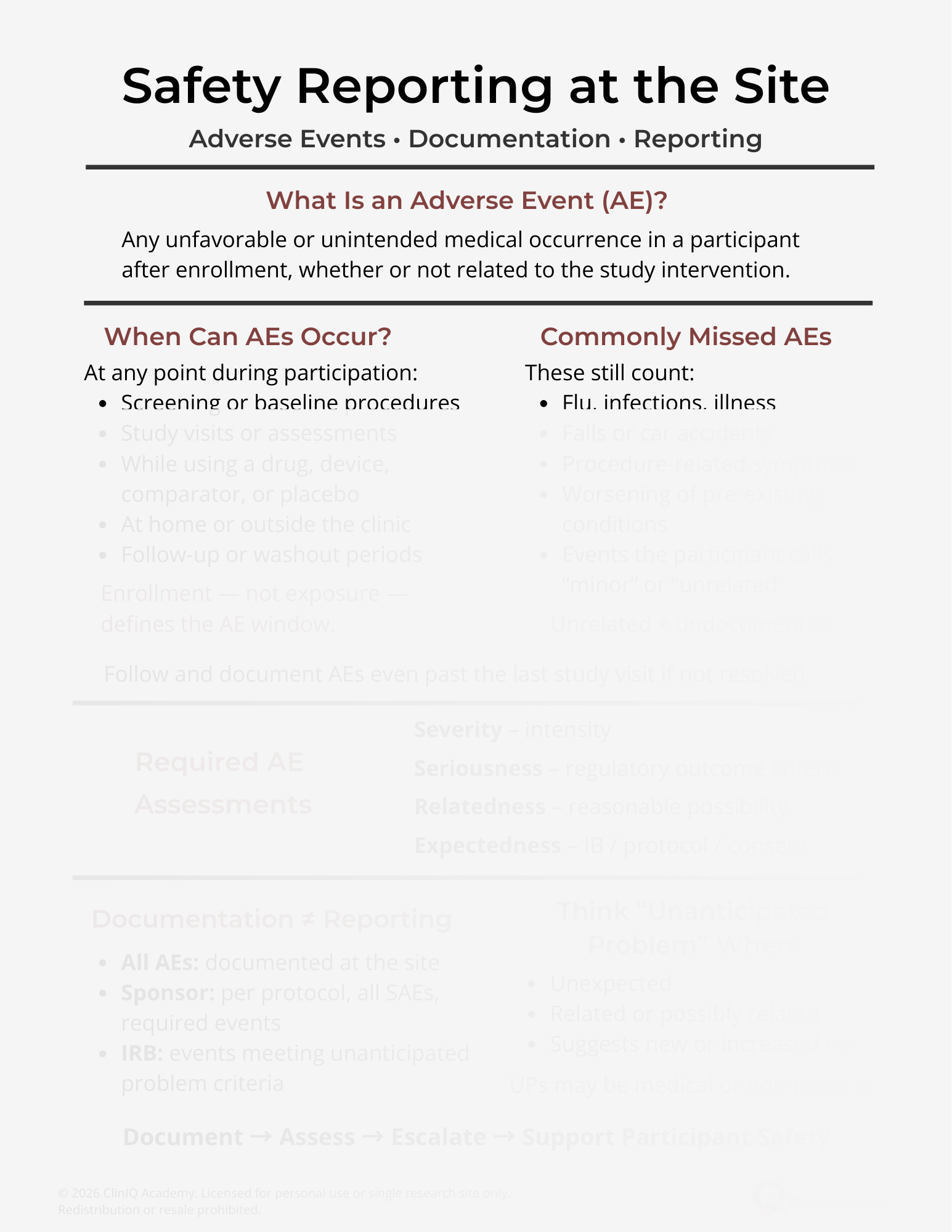
Clarifies when adverse events can occur, including screening, follow-up, at home, and outside the clinic—so nothing important is missed.
Breaks down severity, seriousness, relatedness, and expectedness in plain language, with a focus on how sites actually apply these concepts.
Explains what must always be documented, what triggers sponsor or IRB reporting, and when to think “unanticipated problem.”
Your Go-To Reference for Site-Level Safety Reporting
Adverse event documentation and reporting can feel deceptively simple—until you’re faced with real-world tells like a participant getting the flu, a fall at home, or a symptom that’s “clearly unrelated.” That’s where uncertainty creeps in. This one-page Safety Reporting at the Site guide gives you a clear, practical framework for recognizing, documenting, assessing, and escalating adverse events—without over-reporting or missing what matters. It clarifies when adverse events can occur (spoiler: not just during study visits), what still counts even if unrelated, and how to apply core assessments like severity, seriousness, relatedness, and expectedness. Designed for coordinators, investigators, and site staff, this guide helps translate regulatory definitions into real-world site practice. It also reinforces the critical distinction between documentation and reporting, and when to start thinking “unanticipated problem.” Use it as a desk reference, training aid, onboarding tool, or confidence check when you find yourself asking, “Do I need to document this?” Licensed for individual or single-site use. Full licensing details can be found at catalog.cliniq.academy/pages/license-agreement.
Build confidence in your safety documentation—without second-guessing every decision.
Download the Safety Reporting at the Site Guide and keep clarity within reach.
$5.00